High-Salt Mine Wastewater Evaporation Crystallization
Preface
Mine water is a by-product of coal mining, formed by mixing groundwater, surface water and wastewater. It contains large amounts of suspended solids, heavy metals and dissolved salts, seriously threatening the ecology and wasting water resources—especially in 'coal-rich, water-poor' regions where treatment is particularly difficult. Conventional technologies such as coagulation-sedimentation and filtration can remove suspended solids, but challenges remain for high-salinity and acidic-water treatment.
Process Introduction
Generally, a mine-wastewater treatment process includes three stages: pretreatment, primary treatment and advanced treatment.
The pretreatment stage mainly performs initial treatment of the wastewater, such as equalizing water quality and quantity and removing suspended solids;
The primary treatment stage removes pollutants from the wastewater through physical, chemical or biological methods; processes include coagulation-sedimentation, filtration, adsorption, ion exchange, redox and biological treatment;
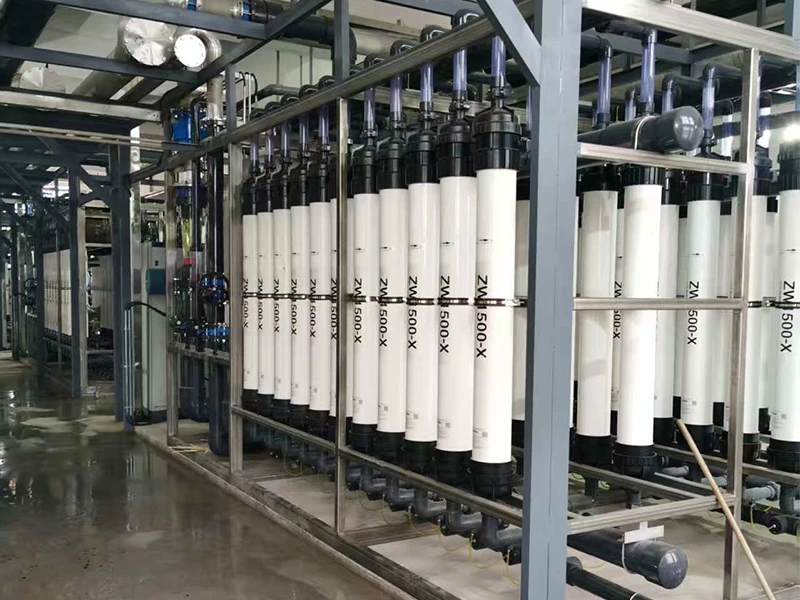
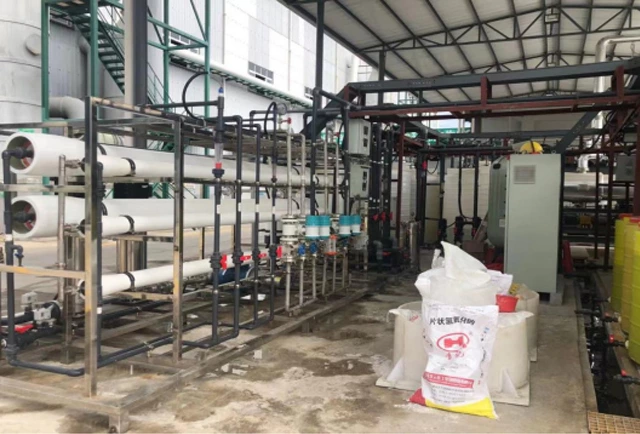
The advanced treatment stage further purifies the treated water to meet reuse or discharge standards. Specific processes include membrane concentration, filtration, recovery, evaporation concentration and crystallization.
During treatment, the appropriate process should be selected according to the specific water quality and treatment requirements of the wastewater.
Typical Water-Quality Characteristics
Mine-water salts differ from ordinary industrial wastewater: dominated by Na+, Cl- and SO4 2-, with high hardness (Ca2+, Mg2+), often containing silica, fluoride, iron, manganese and a little suspended solids; it varies greatly between mining areas. So 'one drawing fits all' does not work.
| Feed TDS | Typical Water-Quality Characteristics | Recommended Main Route | Key Control Points |
| 3000–8000 mg/L | Mainly sulfates and chlorides, medium hardness | Softening + RO/DTRO concentration to 5%–8% | Balance of recovery rate and scaling tendency |
| 8000–20000 mg/L | High hardness, contains silica | Softening & silica removal + high-pressure membrane/DTRO + MVR pre-concentration | Silica and calcium scale; softening is mandatory before membrane |
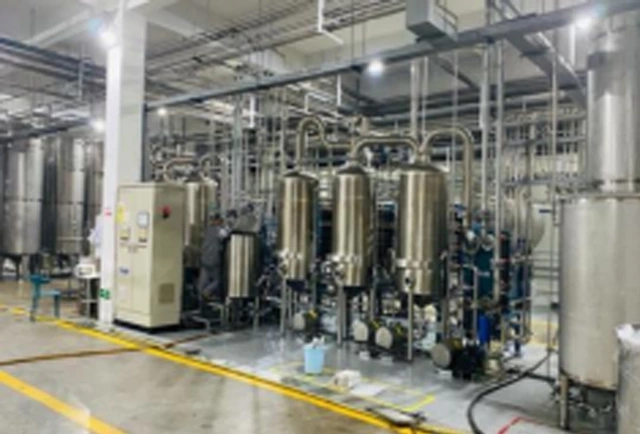
| 20000–50000 mg/L | Close to or exceeding seawater concentration | MVR evaporation concentration + forced-circulation crystallization | Boiling-point elevation (BPE), compressor selection |
| >50000 mg/L or requiring salt splitting | Needs to recover sodium sulfate / sodium chloride | Nanofiltration salt splitting + freezing/thermal crystallization | Crystal-form control, purity and market outlet |
A frequently overlooked physical fact: the higher the salt content, the more pronounced the boiling-point elevation. Taking saturated sodium chloride solution as an example, its atmospheric boiling point is about 9 °C higher than pure water; high-salt mine wastewater can reach a boiling-point elevation of 8–9 °C. This means:
Heat-transfer temperature difference is 'eaten up,' and evaporation capacity drops for the same area;
Compressor inlet temperature, density and specific heat must all be calculated for the solution, not for water;
The number of effects in multi-effect evaporation cannot be copied from samples; the final-effect vacuum must be re-matched.
A Calculation You Can Show the Boss (Example: 1000 m3/d high-salt mine water)
Assumptions: feed TDS 12000 mg/L, concentration ratio 10x, salt production about 12 t/d (mixed salt), annual operation 8000 h.
| Item | Quantity | Unit Price | Annual Cost |
| Power consumption (MVR, 35 kWh/t) | 8.75 million kWh | 0.55 yuan/kWh | ≈ 4.81 million yuan |
| Supplemental steam (0.1 t/t) | 25,000 t | 160 yuan/t | ≈ 4.00 million yuan |
| Scale inhibitor / cleaning chemicals | — | — | ≈ 0.60 million yuan |
| Mixed-salt disposal (12 t/d) | 4000 t | 1000 yuan/t | ≈ 4.00 million yuan |
| Labor + maintenance | — | — | ≈ 1.20 million yuan |
| Total | ≈ 14.60 million yuan/year (about 50 yuan per ton of water) |
If salt-splitting crystallization is adopted to make sodium sulfate 98% pure and sodium chloride 97% pure, the product changes from 'paid disposal' to 'saleable,' which alone can cut the whole line's operating cost by 20%–35%—but only if front-end nanofiltration salt-splitting exists and crystal-form control holds. This calculation is worth settling clearly at the scheme stage.