How to Classify and Treat Electroplating Wastewater?
—From Water-Quality Characteristics to a Zero-Liquid-Discharge Process Route, Explained in Full
'Total nickel exceeded the limit by 0.3x, rectification within a time limit, 300,000 yuan fine.' This is not a joke but the experience of many electroplating plants. They added no less agent and switched processes several times, yet the water still fails. The problem is often not 'whether enough agent was added' but a wrong first step—mixing several completely different wastewater streams together.
I. Why Electroplating Wastewater Is Difficult: Five Streams, Five Temperaments
Electroplating wastewater is never 'one kind of water.' A single production line often discharges several streams of very different nature simultaneously; treating them mixed together is essentially giving up on treatment.
| Wastewater Category | Main Source | Typical Pollutants & Concentration Range | Treatment Difficulty |
| Pretreatment wastewater | De-oiling, pickling, activation | COD 300–2000 mg/L, oil 20–200 mg/L, high SS, pH severe fluctuation 2–12 | Emulsified oil hard to break; large pH shock |
| Cyanide wastewater | Cyanide copper plating, zinc plating, gold/silver plating | CN- 10–200 mg/L, with copper, zinc, etc. | Highly toxic; must be two-stage cyanicide broken separately |
| Chromium wastewater | Chrome plating, passivation, roughening | Cr6+ 20–200 mg/L, pH 2–4 | Must be reduced to trivalent chromium before precipitation |
| Nickel wastewater | Nickel plating, electroless nickel | Ni2+ 5–100 mg/L (electroless nickel contains hypophosphite, citrate and other complexants) | Complexed nickel hard to remove by conventional precipitation |
| Copper/zinc wastewater | Acid copper, pyrophosphate copper, zinc plating | Cu2+ 10–150 mg/L, Zn2+ 10–200 mg/L | Pyrophosphate copper, zincate complexed state hard to treat |
| Waste tank liquor / spent plating liquor | Periodic tank-liquor replacement | Heavy metals hundreds–thousands mg/L, COD up to tens of thousands mg/L | Intermittent high-concentration shock; limited blending required |
| Combined wastewater (after mixing) | Confluence of all above streams | TDS 2000–15000 mg/L, high conductivity | High salt inhibits biology; membrane-concentrate outlet difficult |
The key point: the optimal precipitation pH for copper, nickel and zinc differs; hexavalent chromium must first be reduced to trivalent chromium before precipitation; cyanide must be destroyed separately, otherwise it re-complexes the already-precipitated heavy metals and drags them back into the water. 'Separate classification and separate routing' is therefore the starting point of every compliant scheme.
II. Where Is the Compliance Red Line? First Look at GB 21900-2008 Table 3
| Pollutant | Discharge Limit (mg/L) | Pollutant Discharge Monitoring Location |
| Total chromium | 0.5 | Workshop or production-facility wastewater discharge outlet |
| Hexavalent chromium | 0.1 | Workshop or production-facility wastewater discharge outlet |
| Total nickel | 0.1 | Workshop or production-facility wastewater discharge outlet |
| Total cadmium | 0.01 | Workshop or production-facility wastewater discharge outlet |
| Total silver | 0.1 | Workshop or production-facility wastewater discharge outlet |
| Total lead | 0.1 | Workshop or production-facility wastewater discharge outlet |
| Total mercury | 0.005 | Workshop or production-facility wastewater discharge outlet |
| Total copper | 0.3 | Enterprise total wastewater discharge outlet |
| Total zinc | 1.0 | Enterprise total wastewater discharge outlet |
| Total iron / total aluminum | 2.0 / 2.0 | Enterprise total wastewater discharge outlet |
| pH (dimensionless) | 6–9 | Enterprise total wastewater discharge outlet |
| Suspended solids (SS) | 30 | Enterprise total wastewater discharge outlet |
| Chemical oxygen demand (CODCr) | 50 | Enterprise total wastewater discharge outlet |
| Ammonia nitrogen / total nitrogen / total phosphorus | 8 / 15 / 0.5 | Enterprise total wastewater discharge outlet |
| Petroleum / fluoride | 2.0 / 10 | Enterprise total wastewater discharge outlet |
| Total cyanide (as CN-) | 0.2 | Enterprise total wastewater discharge outlet |
| Base discharge volume per unit product | Multi-layer plating 250 L/m2, single-layer plating 100 L/m2 | Discharge-volume metering location consistent with monitoring location |
Two points deserve special reminder: total chromium, hexavalent chromium, total nickel, total cadmium and other Class-I pollutants are assessed at the workshop or production-facility wastewater discharge outlet—the path of diluting past the limit at the total outfall is already blocked; meanwhile Table 3 also stipulates the base discharge volume per unit product (multi-layer plating 250 L/m2, single-layer plating 100 L/m2), so water volume itself is also an assessed item. This is precisely why electroplating parks have recently rushed to adopt mid-water reuse and concentrated-water zero discharge.
III. How to Choose the Process Route: Three Routes, Progressive Upgrades
Route 1: Separate classification & routing + physicochemical precipitation (basic compliance type).
Cyanide wastewater undergoes two-stage alkaline chlorination (pH 10–11, ORP ≥ 300 mV, then pH 8–9, ORP ≥ 650 mV); chromium wastewater is acidified to pH 2.5–3.0, ORP 250–300 mV to reduce hexavalent chromium, then adjusted back to pH 7.5–8.5 for precipitation; combined heavy-metal water is neutralized and precipitated at copper 8.0–9.0, nickel 9.5–10.5, zinc 8.5–9.5 (zinc is amphoteric and re-dissolves above pH 10), then coagulated-flocculated, inclined-tube settled and sand-filtered. Low investment and short flow, but basically ineffective for electroless nickel, cuprous pyrophosphate and EDTA complexed systems—nickel and copper stay stuck at 0.5–2 mg/L and won't come down.
Route 2: Complex-breaking + advanced oxidation + chelating precipitation (tough-battle type).
At the front end, add Fenton oxidation (pH 3–4) or sodium hypochlorite strong oxidation to break the complexing agent and 'tear' heavy metals from the complexed state into free ions, then capture them with DTCR-type chelating agents or sulfide precipitation; total nickel in effluent can be stably brought below 0.1 mg/L. This is the most used route in current renovation projects.
Route 3: Membrane concentration + evaporation crystallization (reuse and zero-discharge type).
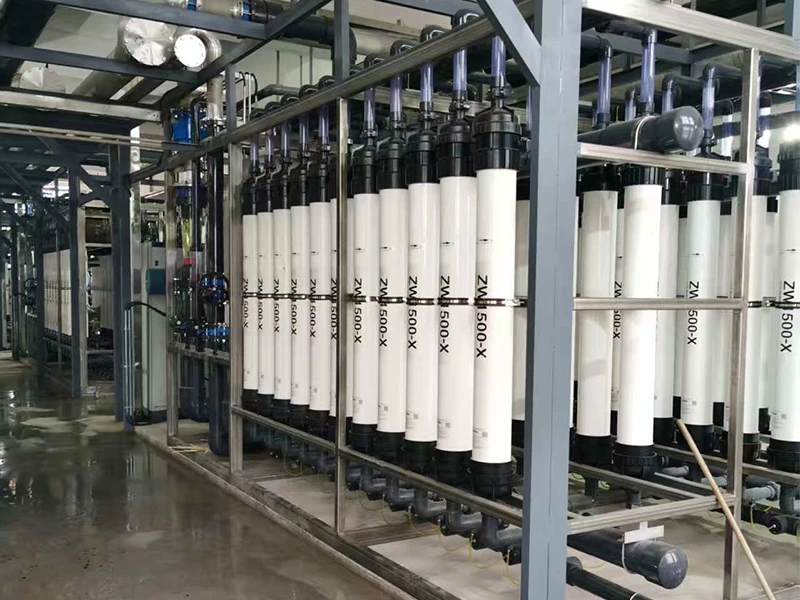
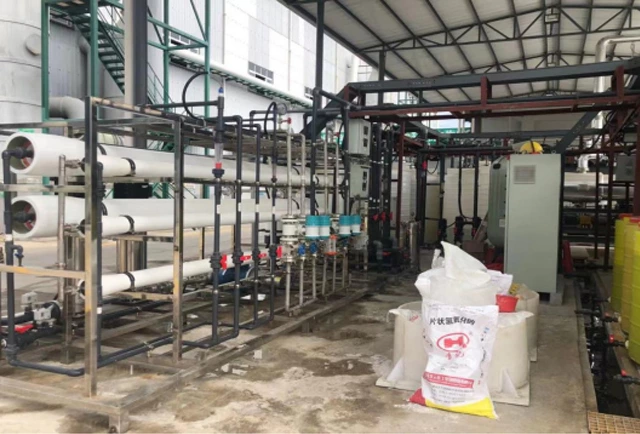
Compliant effluent passes through ultrafiltration -> nanofiltration/reverse osmosis; produced water is reused for rinsing, with reuse rate typically 60%–75%; concentrated water has TDS concentrated to 30000–60000 mg/L, beyond any biological or chemical method and can only enter the evaporator—this step truly determines whether the project can achieve 'zero discharge.'
IV. How to Pass the Evaporation-Crystallization Stage Without Pitfalls
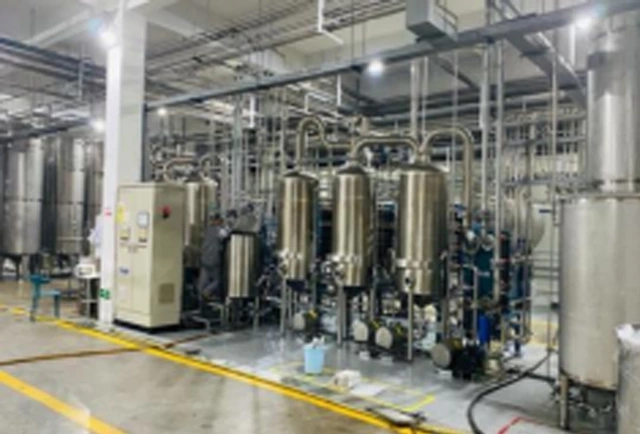
The two big troubles of concentrated water are corrosion and energy consumption. Electroplating concentrated water has high chloride ions; 304 and even 316L can suffer pitting and stress-corrosion cracking, so material must be selected by chloride concentration and temperature: 316L for medium-low temperature, TA2 titanium or 904L for high-chloride high-salt. On energy: traditional single-effect evaporation consumes nearly 1 t of steam per ton of water; MVR recompresses and reuses the secondary steam, with only tens of kWh per ton of water; for small volume or intermittent operation, low-temperature heat-pump evaporation-crystallization runs under 40–70 °C vacuum, cutting energy by 60%–80%, with condensate directly reusable and heavy-metal salts precipitated as crystal salt.
V. 90% of Exceedances Actually Come From These 5 Details
From operating projects, problems rarely lie in the process drawings: a drifting, uncalibrated pH meter shifts nickel precipitation pH by 0.5 units and the effluent differs several-fold; an inaccurate ORP probe means reductant dosing is guesswork; excess PAM instead makes flocs float and carry sludge; a sedimentation tank long un-desludged re-releases heavy metals—we have seen a case where three months without desludging overturned the whole tank; the most concealed is cyanide wastewater mixed into combined water, whose cyanide re-complexes and re-dissolves the already-precipitated heavy metals.
VI. Jiangsu Gaojie Energy-Saving Equipment Group Co., Ltd.: Finish the Last Mile
Jiangsu Gaojie Energy-Saving Equipment Group Co., Ltd. (GOJE Group) has long focused on MVR evaporation, multi-effect evaporation, low-temperature heat-pump evaporation-crystallization and distillation-purification equipment, accumulating extensive engineering experience with high-salt, high-chloride, strongly corrosive materials such as electroplating wastewater. The typical approach is a combined route of 'pretreatment heavy-metal removal + membrane concentration & reduction + low-temperature heat-pump/MVR evaporation-crystallization': the main body uses TA2 titanium, 316L or 904L per water quality, with full automatic control; condensate is reused in production and crystal salt is reduced then consigned for disposal or resource utilization. A Hebei Xingtai electroplating-wastewater project adopted low-temperature heat-pump evaporation-crystallization with a TA2 titanium main body, evaporation capacity 7 t/d, treating mixed wastewater from galvanizing (oily), chromium plating, nickel plating and copper plating, with all condensate reused.
Electroplating-wastewater treatment has no 'panacea,' but it has a clear decision order: first clarify each stream's water quality and volume, then set the routing scheme, then choose pretreatment and complex-breaking paths, and only then select concentration and evaporation-crystallization—reverse the order and the more you spend the more passive you become. If your station is stuck on total nickel or total chromium exceedance, or you don't know where the membrane concentrate goes, just send the water-quality report and flow data. GOJE Group provides free water-quality diagnosis and process-route evaluation, helping you calculate clearly before investing: which money must be spent and which can be saved.